2nd La Scintilla Concert

15. December 2025

Wolfgang Amadeus Mozart: Symphony No. 10 in G major K. 74
Giovanni Battista Sammartini: Symphony in A major J-C 62
Luigi Boccherini: Symphony in C minor op. 41, G 519
Wolfgang Amadeus Mozart: Symphony in A major K. 201

  • Duration :
    approx. 1 H. 35 Min. Inkl. Pause after 1st part after approx. 45 Min.

Music Direction:
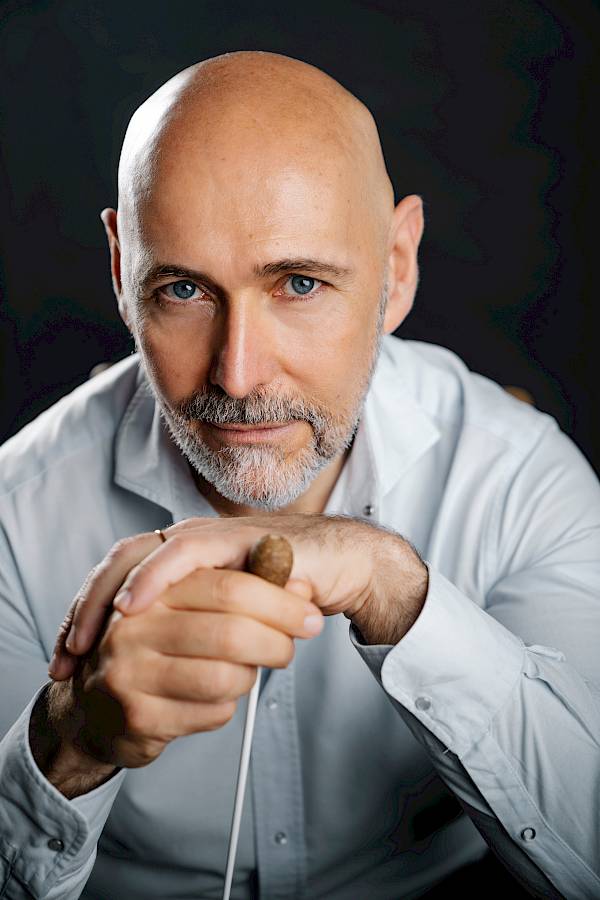
Enrico Onofri

Enrico Onofri

Enrico Onofri was principal conductor of the Filarmonica Toscanini in Parma and currently holds the positions of associate conductor of the Munich Chamber Orchestra, artistic partner of the Haydn Philharmonic, and associate conductor of the Orchestre National d'Auvergne. He is also the founder and leader of the Imaginarium Ensemble and music director of the Real Câmara in Lisbon. Growing up in Ravenna, Italy, Enrico Onofri developed a passion for historical performance practice at an early age. During his violin studies, he was appointed by Jordi Savall as concertmaster of La Capella Reial. He soon collaborated with ensembles such as Concentus Musicus Wien, Ensemble Mosaique, and Il Giardino Armonico, where he was concertmaster and soloist from 1987 to 2010. His conducting career began in 2002, and he received numerous invitations to conduct orchestras, opera houses, and festivals in Europe, Japan, and Canada. He has conducted the Haydn Philharmonic, the Orchestra del Maggio Musicale Fiorentino, the Real Orquesta Sinfónica de Sevilla, the Orchestre de l'Opéra de Lyon, the Vienna Chamber Orchestra, the Orquesta Sinfónica de Galicia, the Real Filharmonía de Galicia, the Akademie für Alte Musik, the Orchestra Ensemble Kanazawa, the Camerata Bern, the Festival Strings Lucerne, the Bremer Philharmoniker, the Basel Chamber Orchestra, and the Bochumer Symphoniker. As an opera conductor, he has worked on productions at the Opéra de Lyon, the Teatro de la Maestranza in Seville, the Teatro Regio in Turin, the Zurich Opera House, and the Staatstheater Halle. In early 2025, he conducted Alessandro Scarlatti's "Il trionfo dell’onore" at the Teatro La Fenice in Venice. In 2019, he won the Abbiati Prize as the best soloist of the year and received numerous prestigious awards for his extensive repertoire of recordings as both a soloist and conductor. In January 2025, he began a collaboration with the Harmonia Mundi label for a symphonic cycle dedicated to Classical composers.

2nd La Scintilla Concert15 Dec 2025

Cast

Ganze Besetzung anzeigen Weniger anzeigen

Orchestra La Scintilla

Die Pflege der historischen Aufführungspraxis hat am Opern­haus Zürich seit dem Monteverdi-Zyklus in den 1970er Jahren Tradition. Bei der folgenden Reihe der Mozart-Opern mit dem Lei­tungs­­­team Harnoncourt/Ponnelle wurde weiter Pio­nierarbeit geleistet, und die Musikerinnen und Musiker passten ihre Spieltechnik den neue­sten Erkenntnissen der historischen Aufführungspraxis an. 1996 formierte sich aus dem Orchester der Oper ein eigenständiges Ensemble von erstklassigen spezialisierten MusikerInnen, das sich einen hervorragenden Ruf erwerben konnte. Der Funke der Begeisterung an neuer «Alter Musik» gab dem Ensemble seinen Namen: La Scintilla – der Funke. Aufführungen mit Koryphäen des Faches wie Nikolaus Har­non­court (u.a. Il ritorno d’Ulisse in patria, Idomeneo), William Christie (u.a. Orphée et Euridice, Les Indes galantes, Orlando), Mark Minkowski (Les Boréades, Giulio Cesare), Reinhard Goebel und Giuliano Carmignola gerieten so erfolgreich, dass das Opernhaus Zürich alle barocken und fast alle aus der klassischen Zeit stammenden Opern von seiner Barockforma­tion La Scintilla spielen liess und lässt. Ausserdem konzertiert das Orchestra La Scintilla der Oper Zürich mit namhaften Solisten – Instrumentalisten wie Sängern – und tritt unter der Leitung von Ada Pesch regelmässig in den gros­­sen Konzertsälen Europas wie der Londoner Royal Festival Hall, dem Concertgebouw Am­sterdam, der Philharmonie Berlin und dem KKL Luzern auf. Äusserst erfolgreich begleitete das Orchester Cecilia Bartoli auf mehrwöchigen Konzertreisen in Nordamerika und Europa (u.a. in der Carnegie Hall).

La clemenza di Tito26 / 29 Apr / 3 / 8 / 15 / 17 / 20 / 25 May 2026 2nd La Scintilla Concert15 Dec 2025 Giulio Cesare in Egitto11 / 13 / 15 / 17 / 21 / 25 / 28 Mar 2026 3. Konzert La Scintilla18 May 2026 Bezuidenhout & Minasi15 Mar 2026 Aci, Galatea e Polifemo20 / 29 Mar 2026 Johannes-Passion24 Mar 2026

Abstract

In December, the second concert of the Scintilla-cycle leads into the Classical era. Under the direction of Enrico Onofri, former concertmaster and soloist with Il Giardino Armonico, works by Giovanni Battista Sammartini and Luigi Boccherini will be performed, as well as two early symphonies by Wolfgang Amadeus Mozart: his "Symphony in G major, K. 74," composed in Milan shortly before the premiere of his opera "Mitridate, re di Ponto," was written when Mozart was only 14 years old. Four years later, he completed the "Symphony in A major, K. 201" in Salzburg. It combines youthful lightness with surprising maturity and represents a highlight of Mozart’s early instrumental music.

Mehr lesen Weniger anzeigen

Good to know

Historically “Inspired”

In conversation with the conductor Enrico Onofri

What inspired you to bring together works by Sammartini, Boccherini, and the young Mozart for this concert?
Their joyful, lively spirit seemed perfect for an Advent concert. This is apparently not the case with Boccherini’s symphonya work the Italian-Spanish composer wrote inspired by the Sturm und Drang movement that was rapidly spreading across central and northern Europe. The symphony is therefore characterised by a dramatic writing style, with the sole exception of the central movement: a pastoral Lentarello that perfectly captures the Christmas atmosphere of southern Europe, accompanied by the calm and merry sound of bagpipes. In addition, Mozart’s Symphony No. 29 represents one of the turning points in his symphonic writing, and I consider this piece a true gift to humanity.

Mozart composed his Symphony in G major at the age of fourteen. What strikes you most about his musical voice at this early stage?

 This small symphony, composed between childhood and adolescence (and therefore perfect for an Advent concert, since the presence of a childlike spirit cannot be missing in a pre-Christmas celebration), is in my opinion Mozart's first symphonic masterpiece, in which the move away from the influence of his father Leopold is already clear. It is a gem both in terms of form and thematic material, and although it is marked by the Milanese gallant style – the symphony is one of the works connected to his visit to Milan in 1770 and his close relationship with the local composer Sammartini – we can already recognise the Mozart of the future. For example, some hints of the “Turkish” style can be found in the last movement, which would then be fully developed in the 1770s and 1780s in the finales of the Violin Concerto K. 219, the Piano Sonata K. 331, and of course “Die Entführung aus dem Serail”.

As a specialist in historical performance practice, how do you balance authenticity with the expectations of today’s audiences?
Authenticity has always been a chimera in music, because every piece of information that comes to us from the past must be realised through our modern experience and the different personalities of musicians. This inevitably means using the tools at our disposal to bring each piece of information to life. There is no doubt that we should strive to get as close as possible to what the sources suggest, but there are differing opinions on how to do so: each interpretation is therefore always, and only, a hypothesis. In this regard, HIP (Historical Performance Practice) has, for years, reached a stalemate, where the standardisation of performances has replaced the keen and curious spirit of investigation that once characterised it. Today, in my opinion, the only meaningful work we can do is to find a balance between what historical sources tell us and our modern sensibilities, avoiding facile extravagances or crossovers, but approaching the music with strength of heart and mind, guided by a renewed spirit of ongoing research. Music is language, and this is precisely what historical sources (if we wish to reduce their complexity to a single principleask of us: to ensure that music speaks to the listener’s soul. We cannot escape filtering it through our modern perspective as interpreters, yet a solid foundation of knowledge and a clear vision of what the score can powerfully convey help us achieve that restless, delicate balance. For this reason, I prefer to define HIP as a more human, and perhaps more honest, Historically “Inspired” Performance.

Is there a piece in this concert that holds special personal meaning for you? If so, why?

They all are, for the reasons I have explained. However, if I may say so, the pastoral movement in Boccherini's symphony strikes a special chord, as it reminds me of my childhood when shepherds from the Abruzzo region still descended from the mountains with their bagpipes into the streets of cities across Italy, loudly yet tenderly playing our traditional Christmas melodies. A tradition that has now disappeared but whose sound — made of reeds and sheepskin — carries the scent of a lost past.